
After Anton Long
Authority and Fragmentation in the Order of Nine Angles

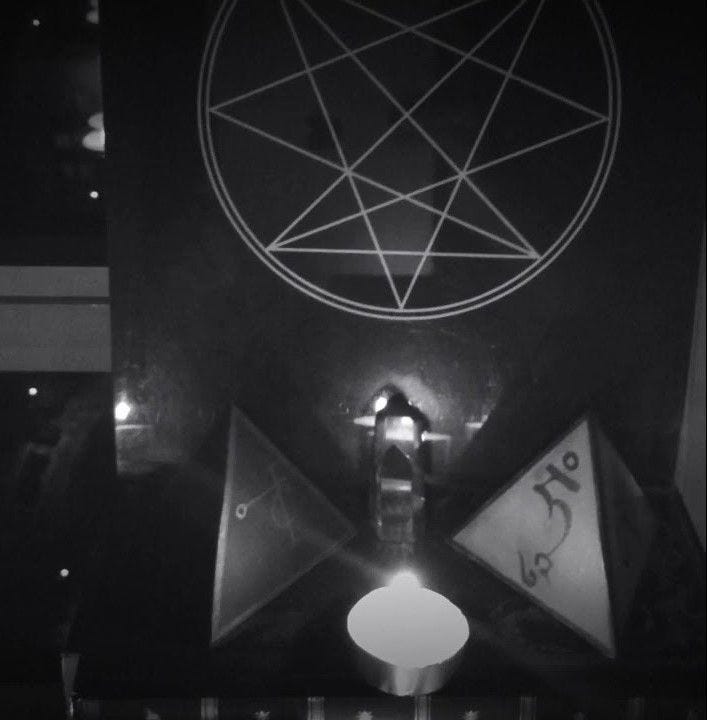
Declaration of Intent
The tripartite distinction advanced here — ONA 1.0, 2.0, and 3.0 — does not originate in internal proclamations of the Order of Nine Angles, nor does it claim to reproduce any authorised doctrinal taxonomy. It is an analytic instrument. It designates structural conditions rather than essences. It marks shifts in authority, medium, and generational reception observable across roughly five decades of textual production, initiatory articulation, ideological entanglement, and transformation in modes of transmission.
The subdivision into various phases was inspired by a document published on the ‘Seven Oxonians’ blogpost titled Deconstructing a Mythos, which stressed a fundamental difference between a pre-internet Longusian Occultism which informed a ONA 1.0 and a later ‘public ONA 2.0 (a/k/a O9A), which utilised ‘the then newly developed public ‘world wide web’, websites, internet forums, message boards, and ‘personal computers’ to disseminate O9A tracts and to encourage individuals to found their own independent ‘nexions’.
Departing from this bipartite division, I propose the existence of 3 different ONA configurations throughout the over five-decades long history of the Order. The boundaries between these configurations are neither dramatic ruptures nor clean succession. Elements later characteristic of ONA 2.0 are visible prior to 2012; aspects of ONA 1.0 persist well beyond it. The model does not describe replacement. It isolates reconfiguration.
The selection of 2012 as the hinge is deliberate. Previous narratives relocate decisive transformation to the early 1990s, presenting that period as the dilution or supersession of an original esoteric philosophy. Yet the 1990s, despite the proliferation of interpretation and the expansion of dissemination, do not displace the authorial centre. Textual production continues under the name Anton Long. The septenary grammar remains intact. The ontological distinction between causal and acausal is reiterated rather than relinquished. The graded architecture of the Sevenfold Way persists without structural revision.
The decisive alteration, in my opinion, occurs only with Anton Long's public withdrawal in 2012. A corpus under active authorship is structurally distinct from a corpus declared complete. Under authorship, ambiguity may be reframed, tension absorbed, deviation elaborated. Under archival conditions, authority becomes retrospective; interpretation becomes lateral rather than gravitational. The distinction appears subtle, but it really isn’t
What follows is most definitely not a narrative of degeneration or purification. It is an account of how symbolic architecture behaves under altered conditions of authority and medium.

ONA 1.0 — The Authorial Architecture (mid-1970s–2012)
The configuration designated here as ONA 1.0 corresponds to the period in which textual production, symbolic vocabulary, and initiatory articulation remained anchored in a corpus attributed to a named — if pseudonymous — authorial presence. The name Anton Long functioned not merely as attribution but as a structural axis.
The late 1970s exhibit accumulation rather than a system. Early ritual outlines, mythic fragments, adversarial rhetoric not yet fully embedded within metaphysical exposition, provisional articulations of septenary symbolism — these materials register experimentation. Satanic imagery, pagan reference, and esoteric praxis intersect without yet achieving architectural integration.
By the mid-1980s, consolidation had become visible. Naos assumes the position of hinge. The Tree of Wyrd is articulated not as a decorative emblem but as an initiatory cartography. The Star Game is positioned as a cognitive discipline rather than a diversion. The Sevenfold Way acquires defined stages oriented toward experiential transformation rather than declarative assent. Structure tightens.
The ontological distinction between causal and acausal becomes systematic. It is no longer a suggestive metaphor but a structural claim regarding consciousness and reality. Aeonic theory situates individual initiation within civilisational temporality extending beyond biography. The initiate’s ordeal is not framed as private eccentricity but as participation in historical scale. Individual strain is inserted into longue durée.
The coherence of ONA 1.0 does not derive from ideological uniformity but from interrelation. Texts cite texts. Concepts interlock. The adversarial stance is framed as a methodological instrument rather than a theatrical provocation. Opposition is operationalised.
The literary corpus performs architectural work. The Deofel Quartet and associated narratives are not ornamental appendices but epistemic devices. Narrative ambiguity destabilises moral certainty. Violence and erotic extremity are staged as conditions of strain rather than endorsements. The reader is denied evaluative stability. Interpretation requires reconstruction rather than consumption.
Density restrains flattening. Aeonic transformation is staged through narrative implication. The literary form slows appropriation by binding vocabulary to affective experience and to cognitive disorientation.
The insistence that there can be “no official interpretation” operates within authorial presence. (We will deal with Anton Long’s ‘authority of individual judgment’ axiom in a future dedicated post). Individual judgment is demanded yet exercised within gravitational coherence.
Engagement with political extremity during this period must be situated within architecture. Insight Roles are framed as dialectical instruments. Whether one accepts this framing is secondary to recognising its structural function. Extremity is positioned as ordeal rather than terminal allegiance, as strain rather than conclusion. It remains contained within initiatory grammar.
The 1990s expanded dissemination through early internet circulation. Interpretive plurality increases. Yet the authorial centre remains active. New texts appear; earlier materials are reframed.
The early 2000s deepened complexity. Mythic layering intensifies. Aeonic speculation expands. The architecture refines itself internally, elaborating rather than retracting its claims. Structural density increases.
By the late 2000s, the architecture exhibits internal completion. The Sevenfold Way appears to stand in full articulation. The ontological grammar is stable. The literary corpus has achieved sufficient density to sustain internal reference without external correction.
ONA 2.0 — The Displacement of Authority (2012–2014)
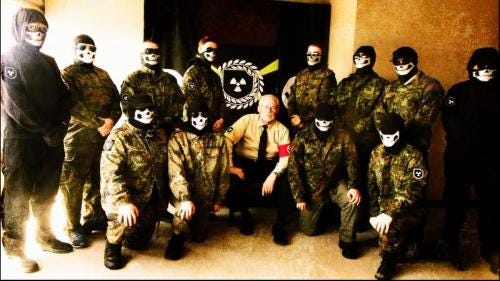
As noted by Connell Monette in Mysticism in the 21st Century, Anton Long announced a withdrawal from public life around 2012. This did not constitute a documented departure from the Order of Nine Angles, but it did mark the cessation of the public author-function that had previously stabilised interpretation and authority. The post-2012 condition is defined not by succession, but by the absence of an authorial centre, leaving the corpus to fragment, mutate, and circulate without restraint.
But Anton Long's withdrawal in 2012 did not immediately lead to fragmentation. There was no formal schism, no rival septenary structure proclaimed superior, no repudiation of the Tree of Wyrd. The corpus remained accessible, mirrored, compiled, and circulated. The architecture stood intact.
The structural condition was altered.
For the first time since the mid-1970s, the corpus existed without an active authorial presence capable of reframing ambiguity or absorbing deviation. Under authorship, tension could be elaborated. Political extremity could be repositioned as an Insight Role. Mythic obfuscation could be defended as a pedagogical device. Ambiguity could be rearticulated within a larger design. With withdrawal, that mechanism ceased.
Between 2012 and roughly 2014, the transformation is subtle. The emphasis shifts toward preservation. The corpus is perceived as complete. Texts are archived in digital repositories. Discussions unfold across forums and encrypted platforms, but the tonal register changes almost imperceptibly. Where interpretive dispute might once have been resolved through reference to ongoing articulation, it now circulates without adjudication.
The principle of “authority of individual judgement,” long embedded within the corpus as an initiatory demand, begins to operate without a gravitational counterweight. In ONA 1.0, this principle functioned paradoxically: judgment was required, yet exercised within the presence of a living architect. After 2012, judgment becomes structurally literal. The architecture remains, but its axis no longer intervenes.
Authority shifts from authorial presence to archival inheritance.
Interpretation becomes lateral rather than vertical. Legitimacy ceases to derive from proximity to a living centre and begins to derive from reputational circulation within dispersed nexions. The absence of rupture obscures the depth of the shift. Nothing has changed doctrinally. Everything has changed structurally.
ONA 2.0 — Horizontalisation and Milieu (2014–2016)
By 2014, the structural consequences of authorial withdrawal begin to register more clearly. The architecture remains formally intact — the Sevenfold Way is neither repudiated nor revised; the distinction between causal and acausal continues to circulate in its established vocabulary; the aeonic framework is not abandoned. Yet the locus of authority no longer converges. What had functioned as a vertically articulated initiatory system gradually presents itself as a constellation of nexions whose legitimacy derives less from supervision than from participation.
This horizontalisation is never announced as doctrine. It merely emerges as a condition.
The Order begins to appear less as a graded ladder and more as a distributed field. The absence of an adjudicative centre does not generate immediate doctrinal chaos; it generates interpretive multiplication. Nexions, kindreds, and small clusters articulate emphases that draw selectively upon the inherited corpus. The Sevenfold Way remains present, yet its exclusive centrality diminishes. Initiatory progression becomes one axis among several rather than the singular measure of authority.
White Star Acception became particularly visible within this configuration. Its stress upon kindreds, decentralised nexions, and Dreccian rootedness corresponded to the structural logic of a post-authorial milieu. The Dreccian archetype — previously embedded within the density of myth and narrative — began to operate more overtly as an emblematic identity. Rootedness, honour, and kinship function less as narrative motifs situated within aeonic drama and more as markers of belonging within dispersed networks.
This shift should not be misconstrued as doctrinal innovation. The vocabulary is inherited. What alters is the weighting of emphasis under conditions of distributed authority.
The principle of individual judgement, once counterbalanced by authorial elaboration, now operated without gravitational correction. In practice, this produced a field in which architectural components could be intensified, marginalised, or reinterpreted according to local preference. Some nexions maintained initiatory focus. Others privileged ideological clarity. Still others emphasised mythic or aesthetic elements detached from graded praxis.
The result was not immediate fragmentation but pluralisation.
At the same time, ideological alignment becomes more explicit within certain formations. Tempel ov Blood articulated positions in the mid-2010s that rendered overt what earlier texts had framed within aeonic or dialectical language. Engagement with National Socialist themes — formerly situated within the grammar of Insight Roles or civilisational temporality — narrowed within some nodes into a declarative posture. The adversarial stance acquired a sharper contour. What had been staged as an ordeal, under decentralised conditions, appeared as an affirmation.
This narrowing, though, appears to me to be structural rather than moral. Under authorial governance, ambiguity was metabolised through elaboration. In its absence, ambiguity required local management. Some nexions preserved dialectical tension; others reduced it. The difference did not reflect purity versus corruption but variation under altered authority.
Material infrastructure intensifies these differences.
Through association with Martinet Press and similar publishing networks, texts associated with ONA circulated alongside works we could classify as explicitly accelerationist. Proximity stabilised in print exerted interpretive pressure. When ONA-derived vocabulary appeared within catalogues that also distributed James Mason’s Siege, adjacency became concrete. Readers encountered metaphysical terminology within discursive environments already oriented toward rupture and immediacy.
The divergence in temporality between aeonic speculation and accelerationist presentism became increasingly pronounced. Aeonic theory situated transformation within long civilisational cycles; accelerationist rhetoric privileged systemic collapse in the immediate present. When these temporal scales intersected within shared infrastructural space, compression occurred. The acausal risks function as an intensifier rather than an ontological horizon; aeonic language contracted toward present urgency.
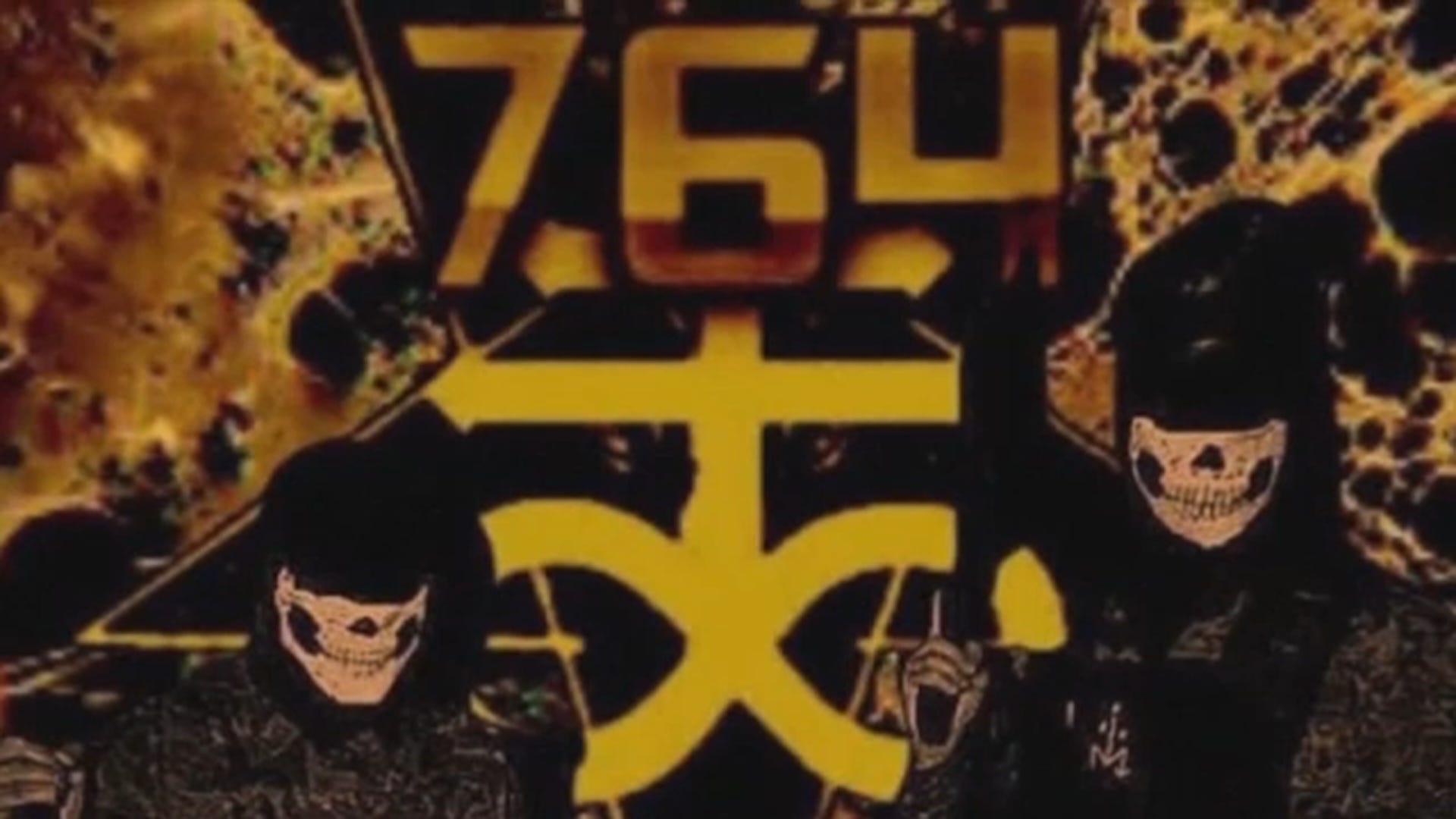
By 2015–2016, formations such as Atomwaffen Division entered public visibility. Their doctrinal centre lay within accelerationist readings of Siege. Yet symbolic gestures and vocabulary resonant with ONA materials appeared within their milieu. This did not establish organisational continuity. It indicated, rather, a migration of language across a decentralised field in which metaphysical terminology was no longer anchored exclusively to initiatory architecture.
Under ONA 2.0, the corpus functioned less as a bounded system and more as a symbolic infrastructure. It supplied vocabulary that could be redeployed in environments that no longer required full immersion in its architectural totality.
This redeployment was facilitated by the absence of an adjudicative centre.
Where ONA 1.0 could recalibrate ambiguity through ongoing articulation, ONA 2.0 had to accommodate divergence without resolution. Some participants continued to reconstruct the initiatory architecture in its entirety, treating the corpus as an archive that required immersion. Others extracted components — adversarial rhetoric, aeonic terminology, Dreccian symbolism — and situated them within ideological frameworks whose primary horizon lies elsewhere.
Between 2014 and 2016, therefore, the transformation remained incomplete but discernible. The architecture persisted. The axis, though, was absent. To put it with Yeats, the centre could not hold. Authority diffused across reputational nexions and infrastructural adjacency. Ideological compression became structurally possible, though not inevitable.

ONA 2.0 — Convergence, Visibility, and External Pressure (2017–2019)
Between 2017 and 2019, the structural logic of ONA 2.0 became increasingly explicit. What had begun as decentralised pluralisation consolidated into convergence under intensified visibility. The absence of a central authorial axis did not yield doctrinal uniformity; it accelerated interpretive reweighting. Symbolic material inherited from ONA 1.0 circulated within a field already saturated by accelerationist discourse. The distinction between initiatory strain and political urgency began to erode at the level of reception.
It would be reductive to describe this milieu as homogeneous. Divergence persisted. Certain nexions continued to prioritise graded praxis and architectural reconstruction. Others privileged ideological clarity or aesthetic posture. The archive remained available to all, while immersion remained elective. Yet the density of adjacency increased.
The interaction between ONA-derived vocabulary and the accelerationist reading of James Mason’s Siege intensified during this period. Mason’s work, originally composed in the 1980s and later republished, advocated decentralised violence and systemic destabilisation. Its temporal horizon was immediate; its scale was insurgent rather than civilisational. When such rhetoric occupied shared infrastructural space with aeonic language, temporal compression became structurally likely. The longue durée of civilisational transformation contracted toward present rupture. The acausal, elaborated within ONA 1.0 as an ontological dimension, was susceptible to reinterpretation as an amplifier of extremity. Pathei-mathos, framed as an individual ordeal, risked reframing in collective or militant terms.
Formations such as Atomwaffen Division, whose visibility increased markedly during these years, illustrate convergence without collapsing distinctions. Atomwaffen’s ideological centre lay within accelerationist National Socialist currents shaped by Siege. Nevertheless, its symbolic repertoire occasionally intersected with vocabulary associated with ONA. This intersection did not constitute organisational continuity; it revealed circulation across decentralised symbolic infrastructure. The corpus, once bound by authorial articulation, now functioned as a reservoir within a broader extremist ecology.
Infrastructure stabilised this convergence. Publishing houses, exempli gratia Martinet Press, provided material continuity that digital volatility alone did not. A catalogue that placed ONA-derived texts alongside accelerationist tracts produced an interpretive environment in which adjacency influenced expectation. Proximity did not dictate reading, but it definitely shaped context. Under such conditions, vocabulary migrated with reduced friction.
External visibility increased in parallel. Arrests associated with accelerationist formations, investigative journalism, and monitoring by counter-extremism organisations amplified public scrutiny. Terms previously confined to subcultural circulation appeared in mainstream reporting. Ambiguity that once operated within insular discourse became legible beyond it. The milieu was no longer self-contained.
Internal tensions sharpened accordingly. For some participants, convergence with militant accelerationism appeared as the fulfilment of an adversarial logic; for others, it signalled the distortion of an initiatory architecture. The absence of adjudicative authority precluded formal resolution. The archive could not intervene. Authority became reputational rather than structural.
Attempts at stabilisation occurred within this volatility. The articulation of outward-facing roles — including the prominence of Chloe Ortega within White Star Acception — reflects an effort to sustain identifiable continuity without reinstating hierarchy. Representation mediated decentralisation, but it did not reconstruct the withdrawn axis. Coherence of voice was offered, but doctrinal convergence was in no way imposed.
By 2019, the convergence had become sufficiently visible to attract sustained external pressure. Law enforcement scrutiny intensified. Media attention broadened. The adjacency between esoteric vocabulary and militant extremity is no longer obscure. The milieu enters a phase in which infrastructural stability itself becomes precarious.
The architecture persisted as an archive. But the field in which it circulated became increasingly unstable.
2020 — Infrastructural Fracture and the End of Convergence
By 2020, the convergence characteristic of late ONA 2.0 reached a threshold beyond which continuation in the same form became untenable. The accelerationist milieu, already under sustained scrutiny, encountered intensified legal and administrative pressure. Arrests, prosecutions, and formal terrorist designations directed at certain accelerationist formations disrupted visible organisational nodes. Online platforms increased enforcement. Publishing networks attracted attention. Channels once semi-public migrated, fragmented, or dissolved.
What fractured was not the ONA doctrine but its modern infrastructure.
The corpus remained intact. The texts continued to circulate in digital form. The septenary architecture had not been repudiated by all. No formal doctrinal schism took place. Yet the infrastructural conditions that had enabled adjacency between ONA-derived vocabulary and militant accelerationist discourse weakened substantially. Convergence had relied upon stable nodes: identifiable nexions, publishing houses, semi-public propaganda channels, reputational figures. As these nodes came under pressure, the circulation patterns began to alter.
The destabilisation appeared uneven. Some formations disbanded. Others rebranded. Still others retreated into encrypted or semi-encrypted environments. Visibility decreased; volatility increased. The field became less legible from the outside and less coherent from within. What had appeared as consolidated convergence proved to be dependent on material and digital scaffolding.
It is important to note that this destabilisation did not erase ideological extremity. It changed the medium through which extremity was articulated. Under increased enforcement, symbolic material circulated in more fragmented forms. Lengthy treatises became less prominent than excerpts. Sustained discussion yielded to an intermittent signal. Public adjacency was replaced by dispersed clusters.
The consequence was a transition in structural condition.
During ONA 2.0, even in its most compressed phase, symbolic migration occurred within relatively stable environments. Participants often encountered extended texts — whether Siege or ONA compilations — in full. Engagement presupposed at least partial immersion. The corpus functioned as infrastructure.
After 2020, infrastructural stability weakens. The archive persisted while the ecology shifted.
This shift marks the threshold of what may be designated ONA 3.0 — not as a new doctrine, nor as a newly constituted organisation, but as an altered condition of circulation.
ONA 3.0 — Post-Infrastructural Circulation (2021– )
The configuration designated ONA 3.0 does not correspond to the emergence of a new septenary schema or revised aeonic manifesto. No doctrinal centre announces transformation. The change is infrastructural and medial. It concerns how symbolic material is encountered, recombined, and transmitted under conditions of heightened volatility.
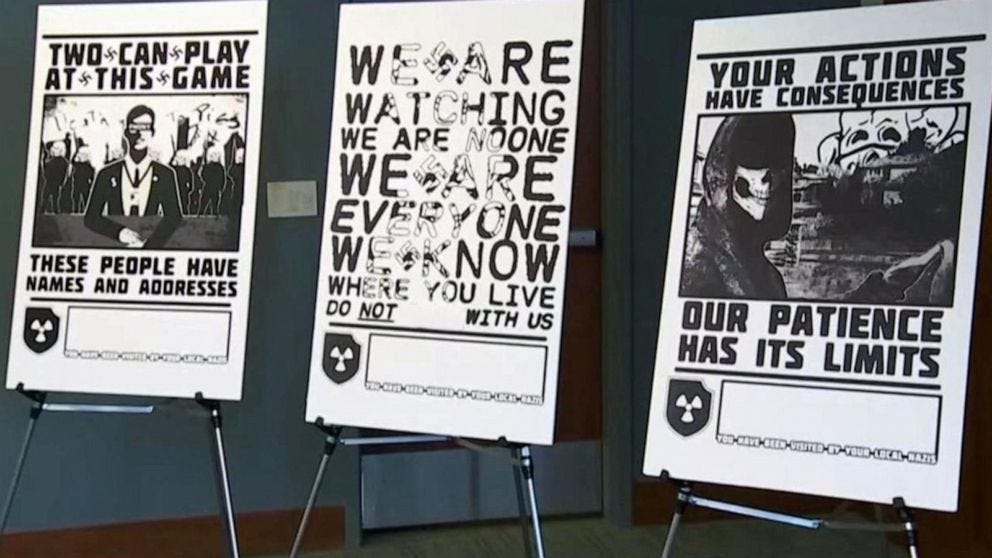
In the early 2020s, digitally native formations became analytically significant. Among these, 764 emerged in online environments, such as Discord, before migrating to encrypted and semi-encrypted spaces. Its rhetoric incorporated accelerationist themes, misogynistic extremity, and encouragement or glorification of violence. Its demographic profile skewed younger than that of the mid-2010s accelerationist milieu.
The relevance of 764 here did not lie in formal lineage. It did not claim custodianship of the Order of Nine Angles. It did not reconstruct the Sevenfold Way. It did not curate the Deofel corpus. Its significance lay in structural exposure.
Within digital clusters associated with 764 and adjacent networks, fragments of accelerationist discourse circulate alongside occasional references to ONA-derived terminology. The acausal appeared sporadically, often detached from ontological exposition. Adversarial rhetoric functioned as an intensifier rather than a methodological instrument. Aeonic language surfaced intermittently without sustained elaboration. These elements do not cohere into architecture; they operate as detachable signifiers.
The distinction from ONA 2.0 is one of depth rather than emphasis.
During ONA 2.0, adjacency between ONA-derived vocabulary and militant discourse remained mediated by identifiable nodes — publishing houses, nexions, outward representatives. Even where compression occurred, extended texts remained accessible and were often read in full. Migration unfolded within relatively stable environments.
Under ONA 3.0, volatility became structural. Digital-native formations operated within ecosystems characterised by platform instability. Servers appear and disappear. Communities migrated rapidly in response to enforcement. Visibility was mediated algorithmically rather than curated through print or reputational hierarchy. In such conditions, sustained doctrinal elaboration encounters friction. Systems requiring immersion competed with memetic fragments capable of immediate circulation.
This does not entail the absence of extremity. Intensity may in fact increase under volatile conditions. What was attenuated was architectural continuity.
Where ONA 1.0 demanded engagement with dense textual and narrative material, and ONA 2.0 still presupposed proximity to infrastructural nodes, ONA 3.0 frequently begins with an excerpt, an image, or a slogan. Initial contact occurred at the level of the fragment. The distinction between archive and inheritance became analytically decisive.
The archive remains fully accessible in digital form. Texts can be downloaded; the Tree of Wyrd can be diagrammed; the Sevenfold Way can be reconstructed. Availability, however, does not guarantee immersion.
Participants socialised entirely within algorithmic ecosystems encounter ideological material through pathways distinct from those of earlier generations. In the mid-2010s, engagement with accelerationist discourse often entailed reading extended texts. ONA materials, when accessed, were typically encountered through compiled PDFs or mirrored archives requiring deliberate search. In the early 2020s, entry points increasingly took the form of screenshots, isolated quotations, or aesthetic gestures. Terms such as “acausal” or “aeonic” functioned as markers of intensity rather than as components within a structured ontology.
This shift reflects mediation rather than incapacity. Platform architectures reward rapid iteration, visual repetition, and affective charge. They do not incentivise prolonged engagement with dense metaphysical exposition. Under such conditions, structural depth thins.
Initiation within ONA 1.0 was structured across time: physical, psychological, and social ordeals integrated into a graded progression. Even literary engagement required sustained attention. In ONA 3.0, duration competes with instability. Communities fragment; conversations migrate; context dissipates. Participation risks becoming performative rather than developmental.
Authority shifts correspondingly. Under ONA 1.0, authority was paradoxical yet locatable within authorial presence. Under ONA 2.0, authority diffused across reputational nexions and infrastructural nodes. Under ONA 3.0, authority becomes circulatory. Content that travels acquires provisional weight. Visibility substitutes for structural coherence.
The name “Order of Nine Angles” persists within certain digital subcultures. Its invocation does not necessarily entail architectural reconstruction. The term functions as a reference point, an aesthetic marker, or a historical signifier. Depth is no longer structurally presupposed.
This condition does not extinguish ONA 1.0. It alters dominance. The architecture remains reconstructible; its monopoly dissolves.
ONA 1.0 Reconsidered — Internal Tensions and Modular Afterlife
To understand the mutation described above, one must return to ONA 1.0, not to restate its features but to examine its internal tensions under altered structural conditions. The authorial configuration achieved coherence through interrelation; it did not eliminate contradiction. The insistence that there could be “no official interpretation” coexisted with unmistakable authorial framing. The rhetoric of adversarial praxis intersected with political extremity without collapsing fully into it. The septenary structure articulated graded progression while simultaneously valorising individual judgement.
Under active authorship, these tensions were generative rather than destabilising. They produced strain without rupture. The authorial axis absorbed ambiguity through elaboration. Apparent deviation could be incorporated; conflict could be reinterpreted; excess could be repositioned within a larger architectural logic. The structure did not depend upon uniformity; it depended upon calibration.
Once the axis withdrew, calibration ceased. What had functioned as dynamic tension became an exposed seam.
The engagement with National Socialist themes provides one illustration. Within ONA 1.0, such engagement was framed variously — as the Insight Role, as an aeonic vector, and as dialectical immersion intended to produce pathei-mathos. Whether that framing persuades is secondary to recognising its placement within graded initiatory architecture and civilisational temporality. Political extremity was not presented as a terminus; it was positioned within a process.
In the absence of authorial recalibration, however, ambiguity surrounding this engagement becomes unstable. The dialectical framing may contract into declarative alignment. What had been articulated as ordeal risks solidified into identity. The risk was always present; the management mechanism changed.
A similar dynamic operates in relation to the acausal. Elaborated as an ontological distinction beyond conventional causality, it functioned within ONA 1.0 through sustained exposition and narrative dramatisation. It was embedded in text, in story, in initiatory mapping. Detached from that embedding, the acausal becomes susceptible to rhetorical redeployment. It may operate as an intensifier rather than a structural claim.
The literary density of the Deofel Quartet performed restraining work. Narrative ambiguity slowed appropriation; it complicated extraction. Yet density presupposes immersion. Under conditions of fragmentation, density ceases to protect and instead becomes a barrier. What once inhibited flattening now simply exceeds attention span.
In this sense, ONA 1.0 contained within itself both resilience and permeability. The architecture was sufficiently complex to sustain ambiguity across decades; it was also sufficiently modular to permit selective extraction once gravitational oversight diminished. The Tree of Wyrd can be diagrammed independently of narrative context. The stages of the Sevenfold Way can be summarised without reconstructing the literary corpus. Pathei-mathos can be invoked without a sustained ordeal. Internal coherence does not preclude detachment.
Under authorial governance, detachment was managed. Under archival conditions, it becomes structurally probable.
This complicates retrospective nostalgia. Unity in ONA 1.0 was not solely doctrinal; it was relational. It depended upon presence. Once presence ceased, modularity facilitated redistribution. Yet redistribution does not equate to disappearance.
The architecture exhibits resilience precisely because it remains reconstructible. The texts have not been erased. The ontological grammar remains legible. Small clusters continue to undertake graded praxis in private or semi-private contexts. ONA 3.0 does not abolish ONA 1.0; it renders it elective.
Elective architecture occupies a different structural position from dominant architecture. It no longer regulates its field by default. It persists through deliberate reconstruction rather than ambient absorption.
The mutation traced across ONA 1.0, 2.0, and 3.0 is therefore not linear decay. It is a transformation in the relationship among authority, infrastructure, and the medium. Under ONA 1.0, authority and architecture were coextensive. Under ONA 2.0, authority diffused while infrastructure stabilised adjacency. Under ONA 3.0, infrastructure destabilises and circulation accelerates, rendering architectural depth contingent rather than assumed.
Whether architectural reconstruction can sustain itself under conditions privileging velocity remains uncertain. Systems requiring duration rarely dominate environments optimised for immediacy. Yet dominance is not identical with survival.
ONA 1.0 survives not because it circulates widely, but because it can be rebuilt by those prepared to engage duration.
Conclusion — Authority, Archive, Circulation
The tripartite distinction advanced here does not posit three distinct Orders, nor does it attempt to stabilise a lineage through normative judgement. It describes three structural configurations under which the name “Order of Nine Angles” has operated, each defined less by doctrinal innovation than by shifts in authority, medium, and conditions of transmission.
During the authorial phase, as designated here as ONA 1.0, architecture and authority were structurally intertwined. The presence of an active axis did not resolve the contradiction; it absorbed it. Political extremity could be articulated as an insight role, reframed within aeonic temporality, or embedded in literary indirection without collapsing the metaphysical grammar that held the corpus together. The density of the Deofel narratives and related prose did not function as ornament but as resistance to reduction. Interpretation requires immersion, and immersion requires duration. Meaning accrued slowly, under pressure, within a field whose boundaries were implicitly maintained by authorial presence.
With the withdrawal of that presence in 2012, nothing doctrinal was formally rescinded, yet the structural condition altered. The corpus did not disappear; it became archival. Authority ceased to operate gravitationally and instead diffused across nexions, publishing infrastructures, and reputational networks. Under this second configuration, ONA 2.0, symbolic vocabulary entered environments increasingly saturated by accelerationist discourse. The temporal scale of aeonic speculation encountered the immediacy of rupture-oriented rhetoric, and the encounter generated compression. Concepts originally situated within initiatory ordeal could be reinterpreted as affirmation; ambiguity that had once been dynamically elaborated required local management. Some formations preserved dialectical tension; others simplified. No central mechanism remained to adjudicate the divergence.
The subsequent configuration, identified here as ONA 3.0, emerges not through doctrinal proclamation but through transformation in media ecology. Platform volatility, algorithmic amplification, and the fragmentation of infrastructural nodes alter the conditions under which symbolic material circulates. Vocabulary travels with increasing independence from architectural depth. Fragments achieve visibility without presupposing immersion in the corpus from which they derive. The archive remains intact in digital form, yet the structural relationship between preservation and inheritance shifts. Accessibility does not guarantee formative engagement; duration is no longer structurally reinforced.
It would be misleading to describe this trajectory as degeneration. The transformation is architectural rather than moral. The same lexicon — acausal, aeonic, adversarial, Dreccian, Sevenfold — can appear across all three configurations while functioning differently within each. Under ONA 1.0, these terms are embedded within an interlocking grammar that disciplines interpretation through time. Under ONA 2.0, they circulate within a decentralised milieu in which adjacency reshapes emphasis and authority is reputational rather than axial. Under ONA 3.0, they may operate as detachable intensifiers within environments that privilege circulation over coherence.
The architecture has not been erased. It remains reconstructible by those willing to engage sustainably with its texts and practices. What has altered is not the possibility of reconstruction but its structural centrality. Engagement with ONA-derived material no longer presupposes immersion in its initiatory architecture; participation may occur at the level of excerpt, symbol, or aesthetic gesture. The shift is one of dominance rather than existence.
To collapse these configurations into a single undifferentiated phenomenon obscures the transformation of authority. To isolate one as authentic and dismiss the others as aberrant ignores how symbolic systems mutate under changing conditions of transmission. The analytic model proposed here does not adjudicate authenticity. It clarifies how the relationship among corpus, authority, and medium has changed over five decades.
The authorial axis no longer regulates the field. The corpus persists as an archive. The contemporary environment is marked by volatility rather than stability. Whether the architectural depth characteristic of the earlier configuration can sustain itself within media conditions that privilege velocity remains uncertain. Systems that demand duration rarely command dominance in environments optimised for immediacy. Their survival depends instead upon deliberate reconstruction rather than structural inevitability.
The name “Order of Nine Angles” now operates across a field broader and less gravitationally ordered than that of its origin. It signifies, depending on context, a preserved corpus, a decentralised inheritance, or a memetic floating reference within digital subcultures. These conditions coexist.
The transformation described here is neither rupture nor extinction. It is a reconfiguration under altered conditions of authority and medium.
The original Deconstructing a Mythos (2025) document may be found at: http://sevenoxonians.wordpress.com/wp-content/uploads/2025/10/gelis-3.pdf
This, from the 'Deconstructing The O9A' part of the 157 page 'Deconstructing A Mythos' may be relevant -
<quote>
"Which leaves us with the question of whether, in the light of a comment Anton Long made in 2023, he expected the O9A to evolve as it has perhaps in order for it to return to the traditional way of covert, personal, recruitment evident in the original O9A and which recruitment was exclusively for candidates seeking to undertake the Seven Fold Way. The comment - in answer to the question "[do] your writings and yours alone define [O9A] esoteric philosophy? - was:
"I would agree that those writings of mine define a particular and possibly unique esoteric philosophy that I developed between the 1970s and the 1990s but with the caveat that that particular esoteric philosophy was only a beginning - ONA 1.0 if you will - and was open to being developed, changed, evolved, 'forked', in the manner of Open Source software, with such 'forked' software renamed accordingly. ONA 1.0 was described in the Naos MSS collection, 1989; in the Deofel Quartet, written between 1976 and 1991, and in the two volumes of The Satanic Letters."
The operative term is "renamed accordingly" since the implication seems to be that such 'forked' developments are no longer O9A and should therefore be distinctly named and have their own identity.
</quote>
Perhaps, therefore, what has been termed ONA 2.0 (and now ONA 3.0) should have a unique name, just as Ubuntu is not Debian but evolved from and is different from Debian.
This, from the 'Unravelling The ONA' part of 'Deconstructing A Mythos', makes a similar point -
"The distinction between ONA 1.0 and the O9A can be understood in terms of an analogy; of ONA 1.0 being a 'closed source' operating system for human being with ONA 2.0 (the O9A) an 'open source' software version of ONA 1.0 and which O9A as open source software developed various 'forks' or versions, as the original Debian i386 version and development of UNIX computer software gave rise to forked versions such as Ubuntu, with Debian itself ported to other computer architectures such as arm64, mips, and S390x. In the tradition of such software development the forked versions of ONA 2.0, developed by others, and thus not solely based on the primary sources of Anton Long's writings between 1976 and 2012, should have been renamed rather than being described by those developers, by academics, and by others, as ONA and/or O9A."
Another interesting and pertinent analysis. Thank you!
It's interesting what 'the Seven Oxonians' wrote re the distinction between ONA 1.0 and 2.0 -
"it is futile to do what a few stalwart old-timers have recently attempted to do - which is to publicly defend what they term ONA 1.0 against the later post-2012 ONA/O9A 2.0"
Which apparently indicates they do not dispute there is or may be such a distinction but that to defend/praise 1.0 over 2.0 (or over 3.0 if Dr. Giudice is correct) is futile. Hence, I guess, why they decided to part ways with the ONA and develop their own Hermetic praxis re the goal of Lapis Philosophicus, noting that the nine aspects of the O9A they enumerated were unnecessary, not relevant, distractive, or detrimental re that individual goal. For those that haven't read their criticism, the nine aspects are -
(i) a public impersonal presence, whether or not anonymous, and whether or not by
modern means such as the Internet;
(ii) Satanism, however defined or presenced, and whether or not used as a personal
learning experience or in an antinomian way;
(iii) the games, deceptions, and the trickery presenced by Anton Long's Labyrinthos
Mythologicus;
(iv) Occult rituals and ceremonies in general, and all types of sorcery;
(v) Insight Roles;
(vi) the causal abstractions and dialectic involved in supporting or using for whatever
reason political forms such as National Socialism;
(vii) the complexity of Anton Long's labyrinthine esoteric philosophy;
(viii) the goal of seeking to presence a New Aeon and to change what-is - such as
society or societies - by any means including but not limited to means which are or
which can classified as political, religious, ideological, social, mythological or Occult;
(ix) the axiom of the authority of individual judgment.